
Observing Oil
Surface Area Due to
Seepage in Lake Maracaibo
- Josh Bridges, Ronnie Featherston, Jarret Garber,
Maria Squier, Whitney Warneke, Shan Zhao -


Discussion
One of the major problems in identifying oil patches was differentiating the oil from look-alike patches. The look-alikes are naturally occurring dark patches that resemble those of oil slicks. These patches can include, but are not limited to, algae, grease ice and internal waves [3]. The algae blooming season in Lake Maracaibo occurs during rainy seasons, which are the months of April, May, October and November [2]. The time span of the gathered data is from late June to early September. It can therefore be concluded that algae did not skew our data. Grease ice is a soupy layer of frazil crystals that, when clumped together, resembles oil slicks. As this occurrence takes place primarily in the Arctic, it need not be considered as a possible look-alike for the study. Internal wave speeds of less than 3 m/s can also be confused for as look-alike patches. This is the case with Lake Maracaibo as the mean velocity of the tidal system is approximately 0.3 m/s [4].
Conclusion
The objective of the study was to determine the extent and validity of the increase of oil seepage which occurred in July of 2010. Under the restrictions encountered in this study and gathered research, it can be confirmed there was indeed a sudden increase in oil seepage. Further research would need to be conducted to verify this conclusion as well as to determine the actual source of the seepage, the volume and surface area of the lake affected and its effects on local ecology and the people living in the area.
 Oil; June 24, 2010 |  Oil Graph; June 24, 2010 |
|---|---|
 Look-a-Like #1; June 24, 2010 |  Look-a-Like #1 Graph; June 24, 2010 |
 Look-a-Like #2; June 24, 2010 | 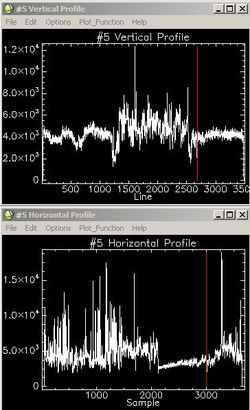 Look-a-Like #2 Graph; June 24, 2010 |
 Water; June 24, 2010 |  Water Graph; June 24, 2010 |


References
[1] Akkartal, A. & Sunar, F. The Usage of Radar Images in Oil Spill Detection. The
International Archives of the Photogrammetry, Remote Sensing and Spatial Information
Sciences, 37, 271.
[2] Hu, Chiuanmin, & Muller-Karger, Frank E. MODIS Detects Oil Spills in Lake
Maracaibo, Venezuela. EOS, 84(33), 314.
[3] Ojeda, Edmundo M. Collective Prevention and Control of Pollution by Oil: Lake
Maracaibo, Venezuela. Environmental Conservation Coordinator, 889, 23.
[4] Redfield, C. & Woods The Tidal System of Lake Maracaibo. Limnology and Oceanography, 6, 7.
ds_0.jpg?itok=Z-thcZsX